Masses and Springs: The Dynamic Physics That Power Motion
Masses and Springs: The Dynamic Physics That Power Motion
At its core, the interplay between mass and springs is a foundational principle shaping everything from simple mechanical systems to advanced engineering marvels. Understanding how masses interact with elastic elements reveals not only the mechanics behind everyday devices but also the deeper laws governing oscillation, energy transfer, and structural dynamics. From the suspension of a car to the delicate tuning of a musical instrument, masses and springs form a powerful duo that governs much of the motion we experience.
The responsiveness of a spring to mass—its stiffness, natural frequency, and energy absorption—lies at the heart of countless technologies, making it a topic of enduring scientific and practical significance.
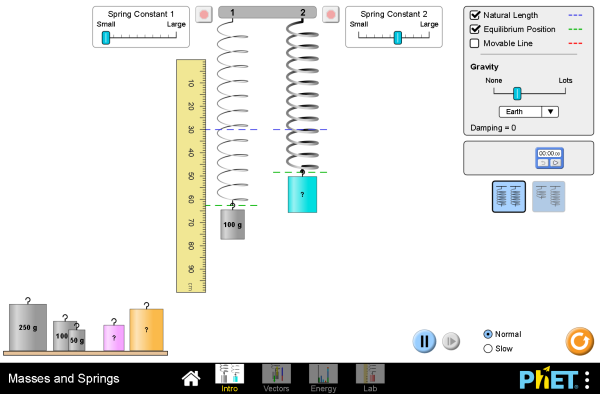
The core relationship between mass and spring force emerges from Hooke’s Law, a foundational concept in classical mechanics. This law states that the force exerted by a spring is directly proportional to the displacement from its equilibrium position, expressed mathematically as F = −kx, where F is the spring force, k is the spring constant (a measure of stiffness), and x is the displacement.
Equally critical is Newton’s second law (F = ma), which ties force to acceleration. Together, these principles explain how a mass connected to a spring oscillates back and forth. When displaced and released, the mass accelerates, stretching or compressing the spring, which in turn generates a restoring force opposing the motion—creating rhythmic back-and-forth movement.
The Role of Natural Frequency and Mass-Load Relationships
One of the most instructive insights in the physics of masses and springs lies in natural frequency—the rhythm at which a system oscillates freely when perturbed.This frequency is determined not only by the spring constant (k) but also by the mass (m) attached to it, following the formula f = 1/(2π)√(k/m). A softer spring with a larger mass results in slower, more deliberate oscillations, while a stiffer spring paired with a small mass produces faster, sharper cycles. Engineers exploit this relationship to design systems that either maximize responsiveness or provide stabilization.
For example, in vehicle suspensions, carefully tuned spring constants ensure smooth ride quality by matching the natural frequency to the road’s dynamic inputs—absorbing bumps without excessive rebound or rolling.
This mass-spring coupling also reveals energy dynamics at play. When a mass compresses a spring, elastic potential energy is stored efficiently, which can later convert back into kinetic energy as the spring expands.
The total mechanical energy in an ideal system remains constant, offering a clean example of conservation in motion. This energy exchange underpins countless mechanisms: from the pogo stick’s rhythmic bounce—where a spring-to-mass system sustains near-perfect oscillation—to the timing mechanisms in clocks, where precise spring elasticity ensures steady power delivery over extended periods.
Real-World Applications: From Microscopic Precision to Massive Structures
Masses and springs transcend theoretical physics, deeply embedded in modern engineering and technology. In precision instruments like atomic force microscopes (AFMs), tiny cantilevers act as micro-springs, detecting minute forces through minute deflections.Each nanoscale oscillation relies on finely balanced mass-spring dynamics, enabling scientists to map surfaces at the atomic level. Similarly, in seismic dampers, large spring systems absorb and dissipate energy from earthquakes, protecting buildings by reducing resonant vibrations that could cause structural failure.
Transportation technology also depends heavily on this principle.
Vehicle suspension systems combine springs and dampers—essentially viscous fluid resistors—to isolate cabins from road shocks. By tuning spring constants, engineers control how quickly the system reacts, enhancing comfort and safety. Even in the aerospace domain, launch vehicle pacing and landing gear systems utilize mass-spring behavior to manage complex vibration environments during takeoff and touchdown, ensuring structural integrity under dynamic loads.
The Science Behind Tuning: Mass, Stiffness, and Damping
The effectiveness of a mass-spring system hinges on three key parameters: mass, spring stiffness (k), and damping.While Hooke’s Law governs equilibrium behavior, real systems always involve damping—the dissipation of energy over time. Excessive damping suppresses oscillations, making systems sluggish; too little causes uncontrolled resonance, risking mechanical fatigue or catastrophic failure. Thus, achieving optimal performance requires careful calibration of all three factors.
Engineers often use analytical models and simulations to balance these elements. For example, in designing a high-performance suspension, virtual prototypes test how varying mass or altering spring properties affect ride dynamics. Advanced materials further expand possibilities: from low-mass carbon fiber springs that minimize inertia to shape-memory alloys capable of adaptive stiffness, responding to temperature or electrical input.
These innovations push the boundaries of responsiveness and efficiency, illustrating how fundamental physics continues to inspire cutting-edge solutions.
Learning from Nature: Biomimetic Inspirations and Natural Mechanisms
Beyond man-made systems, the principles of masses and springs appear throughout the natural world. Insect legs, bird wings, and plant tendrils often incorporate elastic elements mimicking springs—these ‘biological springs’ enable energy-efficient movement, rapid adaptation, and enhanced stability. For instance, flea jumps exploit a protein-based “sifically tuned” spring mechanism, storing and releasing elastic energy with extreme speed and precision.Similarly, the spring管-like structure in some plant roots uses turgor pressure and elastic networks to navigate soil with minimal energy cost.
Studying these natural systems offers powerful insights for engineers—a field known as biomimicry—which leverages nature’s time-tested solutions. Understanding how biological masses interact with elastic elements informs the design of adaptive robotics, soft machinery, and resilient infrastructure.
The elegance of such systems underscores a fundamental truth: the physics behind masses and springs is not just a classroom concept, but a timeless framework embedded in life itself.
In sum, masses and springs form a paradigm of dynamic interaction, illustrating how inertia, restoring forces, and energy flows shape physical systems across scales. From microscopic sensors to industrial machinery, this interplay offers both theoretical clarity and practical impact. By decoding the nuanced relationship between mass, stiffness, damping, and resonance, scientists and engineers continue to innovate, turning natural laws into technologies that move, stabilize, and endure.
As research advances and new materials emerge, the physics of masses and springs remains a vital cornerstone—bridging fundamentals with the future of engineered motion.

Related Post

Unlock Ride the Cyclone: How the Score PDF Redefines Cyclone Risk Assessment

The Unstoppable Rise of Diva Flawless: How an Icon Is Captivating the World
Jason Nash Bio Wiki Age Wife Kids David Dobrik and Net Worth

Track Hurricane Erin in Real Time: Live Map Updates That Keep You Ahead